A compliant-looking GGBS certificate does not prove that every delivery will behave the same way in your concrete. By the end, you will be able to compare measurable product properties, validate test evidence, run meaningful approval trials, and turn supply consistency into a procurement requirement.
Key takeaways
- Compare fineness, chemical composition, strength activity, and soundness on matching test reports.
- Treat fineness as one indicator, not a guarantee of concrete performance.
- Qualify ordinary and Ultra Fine GGBS through trials in your actual concrete mix.
- Require lot traceability, retained samples, and repeat testing after approval.
Which GGBS quality data should you compare before approval?
Approve a GGBS product against measured GGBS quality properties, not a supplier’s generic specification. Compare results from the same sampling basis and ask for the test date, batch or lot number, laboratory identity, measured value, and acceptance limit on every certificate of analysis.
| Property | What to compare | Verification |
|---|---|---|
| Blaine fineness and particle-size distribution | Blaine value, D10, D50, D90, upper tail, and evidence of agglomeration | IS 4031 and ASTM C430 for fineness; agree the laser-diffraction dispersion procedure and reporting basis |
| Glass content and GGBS chemical composition | Glass content, calcium oxide, silica, alumina, magnesia, sulphur, and alkalis | X-ray diffraction or petrographic evidence, plus the declared chemistry; check against IS 12089 and EN 15167-1 |
| Sulphate, chloride, and loss on ignition | Measured contents against project limits | Use the governing limits in IS 12089, EN 15167-1, or ASTM C989/C989M |
| Moisture and bulk density | Moisture at dispatch and loose or compacted bulk density | Record the test method and storage condition because both affect batching and silo capacity |
| Concrete performance | Strength-activity results at project ages, setting time, water demand, and admixture response | ASTM C989/C989M Grade 80, 100, or 120 testing, supported by project-specific mortar or concrete trials |
A nominal “ultra-fine” label is not an ASTM performance class. Treat compliance with EN 15167-1 or ASTM C989/C989M as a baseline, then verify consistency through independent testing and production-scale trials. Low chloride or alkali alone does not prove durability suitability; calculate the complete concrete mix against its exposure classification.
Why fineness alone cannot predict concrete performance
Two GGBS products with the same Blaine fineness can produce different setting time, strength, and durability because fineness measures surface area, not GGBS reactivity.
Granulation quality is established before grinding. Rapid water granulation preserves a reactive glassy phase, while excessive crystalline phases can leave a material slower and weaker despite acceptable chemistry and fineness. The result changes how quickly the binder reacts and how much cementitious contribution it provides.
Grinding history affects particle-size distribution and particle morphology, not just the Blaine value. An Ultra Fine product can improve early-age strength and accelerate reaction, but it can also increase water demand and complicate admixture compatibility, setting time, and rheology.
Compare mortar strength development at the project’s replacement level and curing temperature, then examine:
- Early-age strength, setting time, and heat of hydration, which affect formwork removal, prestressing, and cold-weather production.
- Later-age strength, shrinkage, permeability, and durability, which reveal whether slower reaction delivers lasting performance.
- Water demand and admixture response, which show whether the material will disturb the approved mix.
High replacement levels often reduce early-age strength at low temperatures even when later-age strength improves. Request age-specific mortar results and project-mix trials; a similar fineness number cannot establish equivalent concrete performance.
How should you qualify ordinary and Ultra Fine GGBS in the actual mix?
A laboratory certificate does not prove that a GGBS will produce workable concrete on your project. Run trials with the actual cement, water, admixtures, aggregates, mixing equipment, and curing conditions proposed for production.
1. Compare ordinary GGBS versus Ultra Fine GGBS at the intended replacement levels. Use replacement level trial batches rather than selecting a dosage from supplier literature. Record slump, slump retention, temperature, setting time, air content, density, and water reducer demand.
2. Complete cement compatibility checks with the project cement and sulfate balance. Conduct admixture trials using the proposed mixing sequence, because adding the water reducer before or after GGBS wetting can change dispersion, rheology, and setting. Test for excessive retardation, premature stiffening, bleeding, and loss of workability.
3. Cure specimens at the expected curing temperature, including the lowest temperature relevant to construction. Collect strength-versus-age data at the ages tied to decisions: one, two, seven, 28, and later days where specified. Ultra Fine GGBS can improve early strength, while a higher ordinary GGBS replacement can delay it in cool curing.
4. Repeat the best mix through the actual batching, transport, discharge, vibration, and finishing process. Confirm early strength before formwork striking, prestressing, or opening to traffic; otherwise a mix that passes laboratory testing can still disrupt the programme.
Approve the product only when its workability, setting, heat control, and strength meet the project limits at the proposed replacement level and curing temperature. Record the trial recipe and mixing sequence as the production reference.
How do you control GGBS quality after the first approved load?
Control delivery-to-delivery variation with a written release plan, not one approved load. Require certificate of analysis validation for every lot, recording the test date, batch number, lot number, sampling basis, laboratory identity, measured values, and acceptance limits.
- Compare each result with the approved specification and prior deliveries; investigate trends before they affect concrete production.
- Require retained samples from each delivery for independent testing or dispute resolution.
- Require advance change notification and approval when the slag source, granulation conditions, grinding equipment, or blending process changes.
- Prevent silo cross-contamination by assigning compatible materials to identified silos and cleaning the silo before a product change.
- Use dry sealed silos to block moisture ingress, suitable aeration to maintain flow, and stock rotation to prevent prolonged storage.
- Inspect for moisture, lump formation, damaged seals, and foreign material before unloading.
- Confirm unloading identity against the delivery documents and silo designation before connecting the tanker.
A silo inspection catches damage that a laboratory certificate cannot. Cement, fly ash, limestone, or a previous GGBS product can alter setting, strength, and admixture response without obvious visual warning.
Keep batch-to-pour traceability by linking the delivery batch to the silo, dispatch record, concrete production date, mix code, and pour location. Record the retained sample reference with that chain, so a later strength or setting result can be traced to the material actually used.
What should your final GGBS manufacturer checklist require?
Choose the manufacturer that can control approved performance after qualification, not merely issue a compliant test certificate. Your GGBS manufacturer procurement checklist should require independent verification, production-scale trials, delivery consistency, and evidence that the supplier can sustain results throughout the contract.
- Specify source stability, granulation controls, grinding controls, production capacity, lead time, and lot traceability.
- Define packaging integrity, bulk tanker requirements, unloading identity checks, dry-silo conditions, and maximum storage duration.
- Contract technical support, complaint handling, investigation timelines, and rejected load replacement.
- Require change control before any change in slag source, furnace operation, granulation water, grinding equipment, blending, or laboratory.
| Capability | Evidence to demand | Contract protection |
|---|---|---|
| Standards compliance | Results to EN 15167-1 or ASTM C989/C989M, with independent verification | No substitution based only on a supplier specification |
| Consistency | Retained samples, batch results, notification limits, and production records | Approval before changes exceed agreed limits |
| Supply resilience | Capacity statement, lead-time record, packaging inspection, and tanker plan | Escalation and replacement terms for delay or damage |
| Technical response | Named contact, trial support, complaint records, and corrective-action reports | Time-bound investigation and rejected load replacement |
Ask IVS INDUSTRIES for the same evidence, including how it controls Ultra Fine GGBS batches rather than accepting fineness as proof of equivalent performance. A signed change-control clause protects your mix design when the original certificate no longer describes the delivered material.
Related products
 | Ultra Fine GGBS enhances concrete’s workability, reduces permeability, and ensures long-lasting structural performance. View product → |
 | Ground Granulated Blast Furnace Slag (GGBS) Ground Granulated Blast Furnace Slag (GGBS) ₹2800 Ground Granulated Blast Furnace Slag (GGBS) is obtained during the steel making process, when the slag is uenched to form granules. View product → |
Frequently asked questions
Which GGBS quality data should you compare before approval?
Compare fineness, chemical composition, strength activity, soundness, moisture, sampling basis, test date, batch or lot number, laboratory identity, and acceptance limit.
Why cannot fineness alone predict concrete performance?
Fineness affects reactivity and water demand, but concrete performance also depends on chemistry, glass content, particle-size distribution, dosage, curing, and the cement-GGBS combination.
How should you qualify ordinary and Ultra Fine GGBS in the actual mix?
Run controlled trials using the intended cement, replacement percentage, water-to-binder ratio, admixture, curing conditions, and tests for workability, setting, strength, and durability.
How do you control GGBS quality after the first approved load?
Check each delivery certificate, verify lot identity, inspect storage, retain samples, monitor key test results, and investigate changes in workability, setting, strength, or colour.
What should your final GGBS manufacturer checklist require?
Require defined acceptance limits, consistent sampling and testing, lot traceability, certificates with measured values, trial-mix approval, delivery controls, complaint procedures, and change notification.
Related product
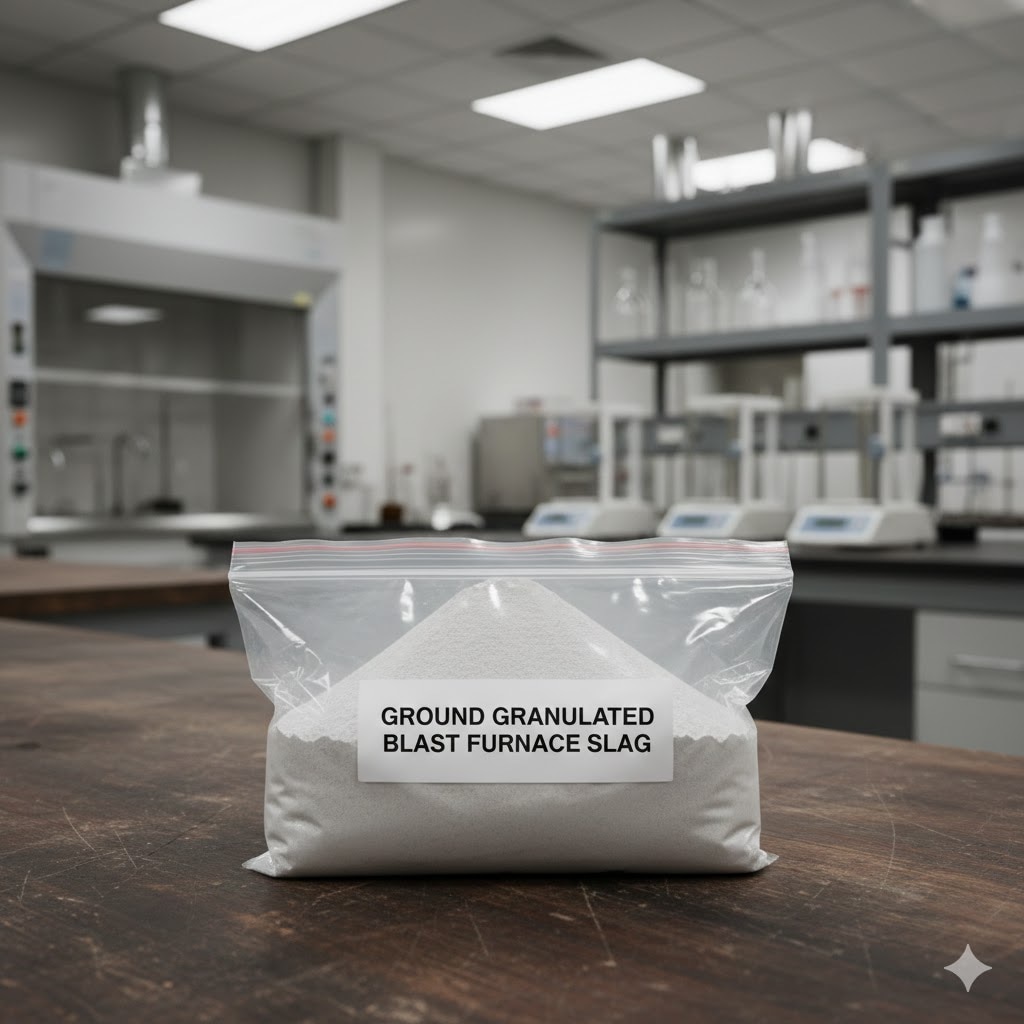 | Ground Granulated Blast Furnace Slag Ground Granulated Blast Furnace Slag ₹3000 State Powdered Packaging Type Bags/Bulker Packaging Size 50 kg bags/ Jumbo Bags Color Off White Grade Technical Application Laboratory We offer... View product → |