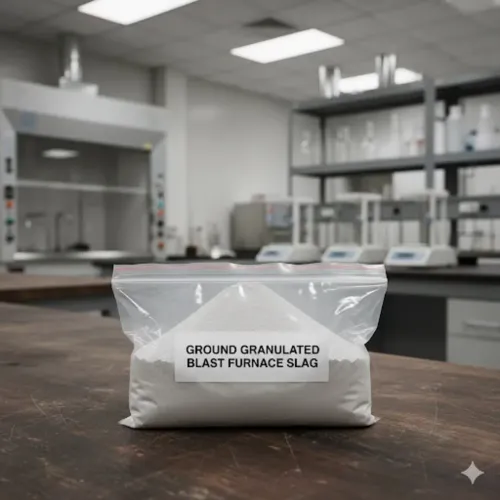
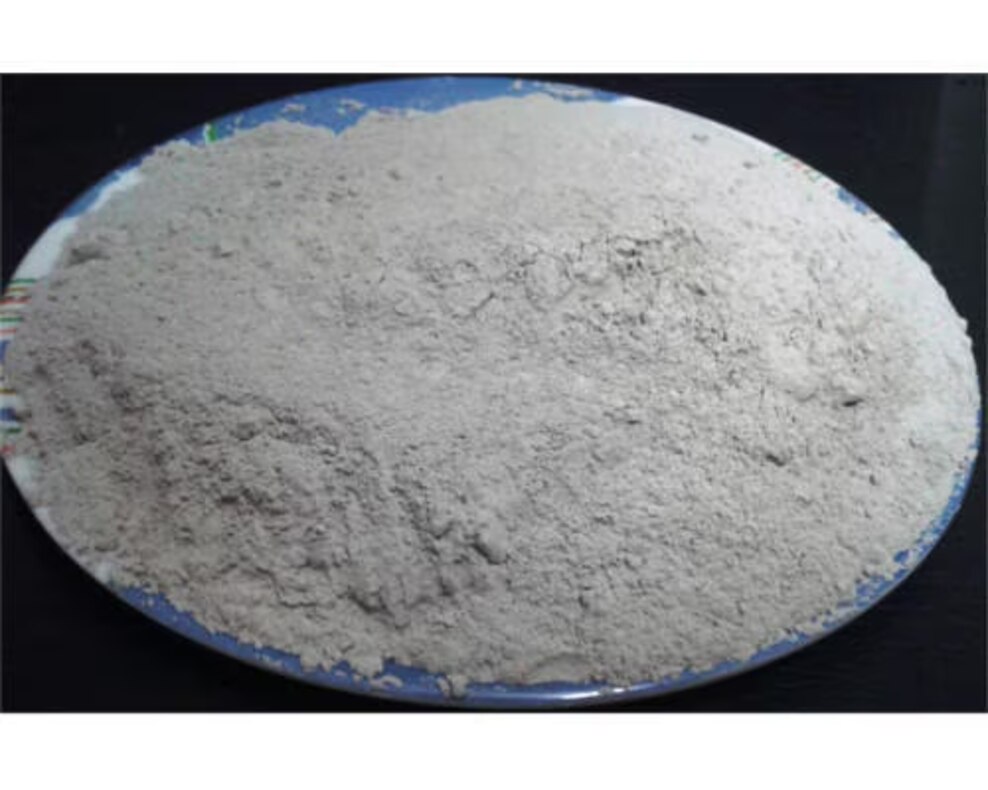
Replacing clinker with GGBS can reduce the Portland-cement fraction, but the result depends on where the material is introduced, how much is used, and how the mix is qualified. By the end, you will be able to compare production routes, select a trial replacement range, adjust batching and curing, and assess the supplier data behind the claim.
Key takeaways
- Use GGBS as a supplementary cementitious material to reduce Portland clinker.
- Set replacement rates against strength, heat, finishing and curing requirements.
- Add GGBS with cement during batching and verify uniform dispersion.
- Request test certificates, batch details and consistency records before accepting supply.
How GGBS lowers clinker content in cement and concrete
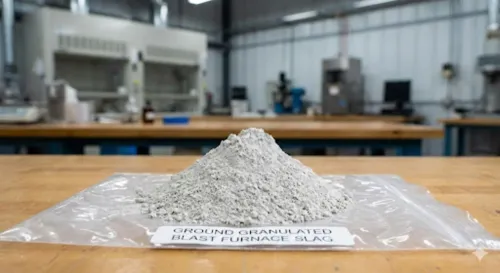
GGBS replaces clinker by becoming the supplementary cementitious material portion of the binder. Portland cement hydration creates the high-pH environment that activates GGBS, allowing it to form additional cementing compounds rather than acting as an inert filler. The result is lower-clinker cement or concrete with less Portland clinker per cubic metre.
| Production route | How GGBS clinker replacement works | Where the replacement occurs |
|---|---|---|
| Interground blended cement | GGBS and clinker are ground together, then sold as one blended cement | Cement plant |
| Separately blended cement | The manufacturer combines finished cement and GGBS before dispatch | Cement plant or blending facility |
| Ready-mix concrete | The concrete producer doses GGBS alongside Portland cement, aggregates, water and admixtures | Concrete batching plant |
In the ready-mix route, GGBS reduces the clinker fraction without changing the cement bag itself. Do not treat it as an automatic one-for-one substitution: the binder ratio, water demand, admixture dosage and specified-age strength require trial batches.
The carbon reduction depends on the replacement rate, slag drying and grinding energy, transport distance and the method used to allocate blast-furnace emissions. GGBS also replaces part of the faster-reacting clinker, so it generally lowers heat evolution and early temperature rise.
That benefit can reduce thermal-cracking risk, but it does not replace a project-specific thermal-control assessment.
Choosing a GGBS replacement rate without sacrificing project performance
Start with 20–30% GGBS replacement percentage of total binder for ordinary structural concrete when early-age strength and normal formwork cycles matter. Move toward 35–50% for mass concrete, marine exposure or chloride-controlled work when lower heat and later-age strength outweigh slower reaction. Rates above 50% require project-specific trials and disciplined curing.
| GGBS dosage | Suitable starting uses | Main performance trade-off |
|---|---|---|
| 20–30% | General reinforced concrete, precast elements with moderate strength demand | Small reduction in early-age strength; later-age strength can match or exceed the reference mix |
| 35–50% | Mass concrete, foundations, marine structures and durability-led work | Lower heat generation and improved permeability resistance, but slower setting and strength gain |
| 50–70% | Large pours or highly durability-focused designs with flexible construction schedules | Strong later-age performance and very low heat, with greater risk of delayed early strength, especially in cold weather |
Treat these bands as trial points, not automatic prescriptions. Test the proposed mix at the specified acceptance age, because a 28-day result can hide a failure at seven days or an unnecessary strength surplus later.
Do not assume Ultra Fine GGBS permits the same concrete at a higher replacement rate. Finer particles can improve reaction and early-age strength, but they can increase water or admixture demand and agglomerate during handling. Compare slump retention, setting time, air content, curing response, shrinkage and compressive strength before approving the dosage.
A cement certificate cannot replace that evidence.
A practical batching sequence for GGBS concrete
Set the replacement on total binder mass, not as an automatic one-for-one swap. For a 40% GGBS target and 400 kg/m³ total binder, use 240 kg clinker or Portland cement and 160 kg GGBS, then qualify water and admixture demand through trial batches.
1. For interground GGBS, select a certified blended cement with the declared slag proportion and dose it as one binder. Do not add another 40% GGBS unless the mix design deliberately targets a higher total replacement.
2. For cement plant blending, combine measured GGBS with clinker or Portland cement to reach the approved binder ratio before dispatch. Verify the blend’s fineness, uniformity and moisture; a silo proportioning error changes strength and setting across the whole load.
3. For ready-mix concrete, weigh GGBS and cement separately at the batching plant, using the total binder target from the approved mix. Keep the water-to-binder ratio unchanged initially, then adjust water only after measuring slump, strength and durability performance.
4. Load aggregates consistently, add part of the mixing water, and disperse the cement and GGBS before introducing the remaining water. This reduces dry pockets and slag agglomeration, especially with fine powders.
5. Add the approved high-range water reducer with the final water portion, not by copying the Portland-cement dosage. Check slump retention, setting time, air content and specified-age strength; cold weather and high GGBS content can require a revised admixture sequence or dosage.
Managing strength, heat, finishing and curing after the replacement
GGBS often lengthens GGBS setting time and reduces early strength, especially in cold weather or at high replacement rates. Later-age strength can match or exceed a Portland-cement-rich reference, so approve the mix against its specified-age strength rather than relying only on 28-day results.
Do not transfer Portland-cement admixture dosages unchanged. Measure:
- Slump and slump retention
- Setting time
- Early-age compressive strength
- Air content
High-range water reducers, low water-to-binder ratios and warm curing can reverse the apparent delay, while poor compatibility can cause rapid slump loss or finishing problems.
GGBS generally lowers heat of hydration and the peak temperature in mass concrete, reducing thermal-cracking risk. Member size, cement chemistry, replacement level, insulation, ambient temperature and curing still require a thermal-control analysis; slag is not a substitute for one.
A slower surface set can delay floating and trowelling, so coordinate finishing with actual setting results. Meet the GGBS curing requirements by preventing moisture loss and maintaining curing temperature for the specified period; inadequate curing can leave a weak, permeable surface. Base formwork striking on in-place strength and temperature history, not a standard calendar interval.
Trial Ultra Fine GGBS when you need faster reaction or higher early strength at the proposed replacement rate. Compare it directly with ordinary GGBS: finer particles can increase water or admixture demand, grinding energy and agglomeration risk. Do not assume Ultra Fine GGBS is a one-for-one substitute.
The quality documents that make a GGBS supply dependable
Approve a manufacturer only when its quality file links each delivered lot to a product standard, test results and a traceable production record. A cement certificate alone cannot prove that your proposed mix will meet strength, setting, permeability or curing requirements.
GGBS quality checks to compare include:
- EN 15167-1 compliance for concrete, mortar and grout, or ASTM C989/C989M where that standard applies
- Certificate of analysis for chemical composition, moisture, loss on ignition, Blaine fineness, particle-size distribution and strength activity
- Test evidence for glass content in GGBS, not just a generic description of the material
- Lot-to-lot variability data covering fineness, moisture, chemistry and strength activity
- Records showing controlled drying, grinding, silo discharge and protection from rain and condensation
| Document | What to verify | Why it matters |
|---|---|---|
| Certificate of analysis | Lot number, test date, results and acceptance limits | Exposes variation hidden by a typical value |
| Traceability record | Slag source, production date, silo, dispatch and retained sample | Lets you investigate a failed delivery |
| Storage record | Moisture checks, caking observations and silo-flow checks | Moisture ingress causes dosing errors and blocked discharge |
| Performance report | Results at your replacement rate, curing regime and specified test ages | Connects material quality to project acceptance |
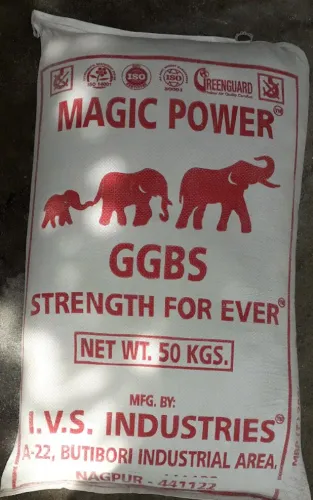
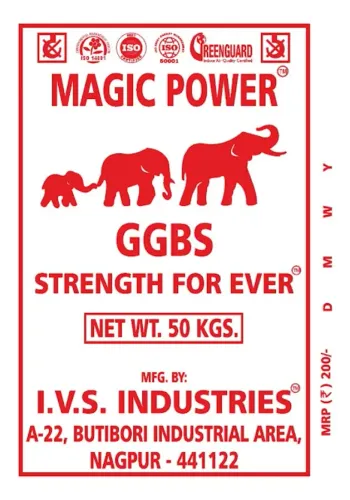
Ask IVS INDUSTRIES, or any shortlisted supplier, for trial data using your cement, admixtures and replacement rate. Compare Ultra Fine GGBS separately: finer grinding can improve early reaction, but it can increase water or admixture demand and agglomeration risk.
Related products
 | Ultra Fine GGBS enhances concrete’s workability, reduces permeability, and ensures long-lasting structural performance. View product → |
 | Ground Granulated Blast Furnace Slag (GGBS) Ground Granulated Blast Furnace Slag (GGBS) ₹2800 Ground Granulated Blast Furnace Slag (GGBS) is obtained during the steel making process, when the slag is uenched to form granules. View product → |
Frequently asked questions
How does GGBS lower clinker content in cement and concrete?
GGBS replaces part of the Portland cement binder. Portland cement hydration provides the alkaline environment that activates GGBS, which then forms additional cementing compounds.
How do you choose a GGBS replacement rate?
Set the rate against the required strength-development profile, heat control, exposure conditions, finishing needs and available curing. Validate the selected proportion with trial batches before production.
What is a practical batching sequence for GGBS concrete?
Measure GGBS and cement accurately, introduce them with the other dry binder materials, add aggregates and water under controlled mixing, then check workability and uniform dispersion before placement.
Which documents support a dependable GGBS supply?
Review the product specification, certificate of analysis or test certificate, batch or lot number, production date, test results and records confirming consistency between deliveries.
Related product
 | Ground Granulated Blast Furnace Slag Ground Granulated Blast Furnace Slag ₹3000 State Powdered Packaging Type Bags/Bulker Packaging Size 50 kg bags/ Jumbo Bags Color Off White Grade Technical Application Laboratory We offer... View product → |