A low price or a favourable test certificate does not prove that a GGBS manufacturer can support an infrastructure project through mix approval, repeated deliveries and schedule-critical concrete work. By the end, you will have a weighted supplier scorecard, a defined testing package, a practical trial procedure and a checklist for verifying supply continuity.
Key takeaways
- Score suppliers against strength, consistency, supply and qualification risks.
- Request certificates for chemistry, fineness, activity and setting performance.
- Run trials using the exact cement, aggregates and admixtures in your mix.
- Approve only suppliers who prove lot consistency and programme-level delivery capacity.
Score Manufacturers Against the Risks That Affect Your Project
Before requesting commercial quotations, give each candidate a weighted score out of 100. Make GGBS manufacturer selection reflect project failure costs, not the lowest quoted tonne price: early-strength delays, inconsistent rheology, interrupted concrete production and an unqualified replacement source can cost more than the material.
| Criterion | Weight | Evidence to compare |
|---|---|---|
| Source control | 25 | Identified granulation and grinding plants, glass-content data, XRF chemistry, and written change notification |
| Grinding consistency | 20 | Recent lot results for Blaine, particle-size distribution, moisture, density and strength activity |
| Concrete qualification | 20 | Plant-specific trials using your cement, aggregate, replacement percentage and curing regime; results at 1, 3, 7, 28 and 56 days |
| Capacity and continuity | 20 | Available bulk capacity, dispatch lead time, storage arrangements, delivery contingency and a technically equivalent secondary source |
| Quality records and support | 15 | Certificates of analysis, mill reports, sampling plan, retained samples, IS 12089 or EN 15167-1 evidence, and responsive technical assistance |
Increase the concrete-qualification weight when stripping, prestressing, traffic opening or winter pours depend on 1- to 7-day strength. Increase continuity weight for remote sites or single-source supply. A certificate alone does not prove schedule performance or rheology.
Shortlist manufacturers that pass every critical threshold, even if their total score is high. Treat undefined “ultra-fine GGBS,” missing glass-structure results or unexplained process changes as gaps requiring resolution before price comparison. That is disciplined supplier evaluation, not a purchasing formality.
Request Test Evidence That Goes Beyond Blaine Fineness
Blaine fineness alone cannot establish suitability: two GGBS lots with the same surface area can produce different strength, setting and rheology. Request a certificate of analysis for each lot, linked to a batch number, test date, method and laboratory—not a generic product brochure.
Ask for:
- A conformity statement against IS 12089, with EN 15167-1 evidence where that standard applies.
- Laboratory reports using the applicable parts of IS 4031, including chemical composition, fineness, soundness, setting time and strength activity.
- Particle-size distribution reported as D10, D50 and D90, or residue on a named sieve. For “ultra-fine” material, also require Blaine or BET surface area; the marketing label is not a specification.
- Glass content or glass-structure results, plus XRF chemistry, loss on ignition, moisture, sulphate, chloride, alkali content and density.
- Strength-activity results at the ages named in the project specification. Request ASTM C989/C989M results where relevant, because Blaine does not measure performance.
- ASR evidence using the proposed aggregate and binder combination, such as ASTM C1567 or the specified equivalent.
Compare the evidence against the concrete specification and approved trial values:
| Evidence | What it reveals | Acceptance basis |
|---|---|---|
| Strength activity | Early and later-age contribution | Required project ages |
| PSD and moisture | Water demand and batching consistency | Stated delivery limits |
| Chemistry and glass content | Reactivity and durability risk | IS 12089 or project limits |
| Setting-time results | Construction and finishing risk | Mix-specific schedule |
| ASR test | Mitigation with the actual aggregate | Specified expansion limit |
Qualify the Material in the Exact Concrete Mix You Will Build
Run the trial with the exact Portland cement, polycarboxylate admixture, water-to-binder ratio, cement replacement percentage and curing regime specified for construction. A GGBS concrete mix design that works with one cement can show different water demand, setting or strength with another because sulfate balance, alkali content and binder chemistry change together.
- Produce a control batch with Portland cement alone and trial batches at the proposed cement replacement percentage. Keep aggregate grading, batch temperature, mixing sequence and admixture dosage fixed.
- Measure water demand at the target slump, slump retention, air content and setting time. A small change in sulfate balance can delay setting or reduce admixture response, causing finishing delays or an unexpected water increase.
- Test compressive strength at the project’s decision ages, not only at 28 days. Compare early strength, later-age strength and the supplier’s strength activity result against limits set before the trial.
- Measure heat of hydration when the pour is thick, restrained or exposed to thermal-cracking risk. Do not accept a generic “cooler concrete” claim without a result using the selected binder system.
- Qualify durability against the actual exposure: specify the test, exposure condition and test age for chloride ingress, permeability or another governing mechanism. Later-age improvement does not prove protection against every exposure.
- Repeat the approved mix after transporting and storing the GGBS in the proposed silo. Check moisture, caking, discharge and feed stability, then retain samples from each trial lot for comparison.
Prove Lot-to-Lot Consistency Before You Approve the Supplier
A certificate is a snapshot; lot-to-lot consistency requires controls that let you trace, test and investigate every delivery. Define a lot in the purchase specification, such as one production period or a stated tonnage, and require a representative sample from each lot rather than one sample for an entire shipment.
1. Require the manufacturer to sample the loading stream or silo discharge using multiple increments combined into a composite. Test each lot for moisture, Blaine fineness or particle-size distribution, density, chemical composition, sulphate, chloride, loss on ignition and strength activity against agreed limits.
2. Make batch identification visible on the certificate, delivery note, silo record and sample label. The code should link the material to its grinding line, granulation source, production date, loading point and test results.
3. Require sealed retained samples from every dispatched lot, stored under dry conditions for the project’s claim and warranty period. Keep enough material for repeat testing; an unlabelled jar or a sample taken only after silo discharge cannot resolve a delivery dispute.
4. Require written quality change notification before any change to the grinding source, granulation source, equipment, process settings, blending practice or test method. Set a trigger for renewed concrete trials when the change could affect setting, rheology or early strength.
Review results as a trend, not as isolated passes. Rising moisture, drifting fineness or changing sulphate values can expose a process problem before one delivery fails.
Reject suppliers that cannot provide these records, preserve traceable retained samples or commit to requalification after a notified change. That evidence proves repeatability—not merely one good test.
Match Delivery Format and Capacity to the Construction Programme
Confirm supply against the concrete programme, not just the annual production figure. Convert the pour schedule into weekly GGBS tonnage, peak-day demand, delivery frequency and minimum reserve, then ask the manufacturer to show dispatch capacity for those exact periods.
Match the delivery format to your handling system. Bagged GGBS suits small or intermittent consumption but adds unloading labour and exposure to torn or damp bags. Jumbo bags require certified lifting equipment and dry storage.
Bulk tanker supply removes bag handling, but only works if the tanker can connect safely and your silo capacity, level alarms, filters and aeration system can receive the load without blocking production.
- Request a plant-specific delivery plan showing loading location, lead time, truck turnaround, delivery slots, maximum daily tonnage and an emergency contact.
- Check that each load arrives sealed, weighed and identified by batch or lot number, with its certificate of analysis and delivery record.
- Require a minimum on-site reserve measured against peak consumption and the supplier’s replacement lead time; a full silo is not usable capacity if bridging or caking prevents discharge.
- Test the unloading route, tanker connection, dust control, earthing and spill response before the first production pour.
- Obtain a written contingency: alternate dispatch point, technically equivalent replacement material, additional vehicles and notification time after a mill, grinding source or transport failure.
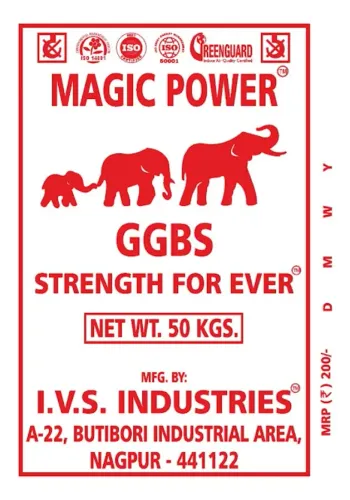
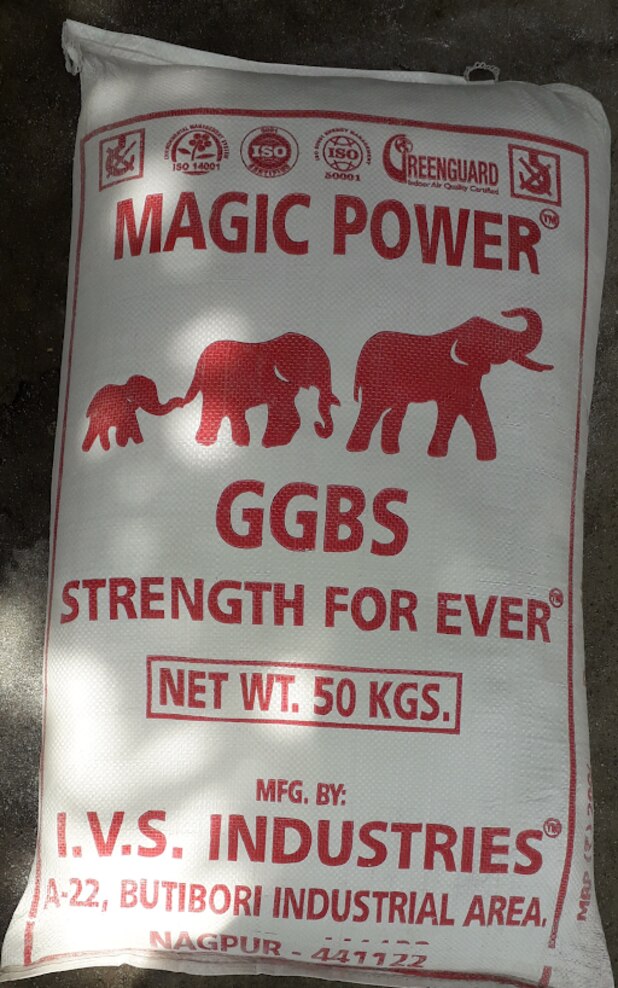
For a supplier such as IVS INDUSTRIES, use the same trial delivery and unloading checks as for every shortlisted manufacturer; packaging availability alone does not prove uninterrupted supply. Compare delivered lots for moisture, fineness and density against your acceptance limits before releasing the supplier for full production.
Related products
 | Ground Granulated Blast Furnace Slag Ground Granulated Blast Furnace Slag ₹3000 State Powdered Packaging Type Bags/Bulker Packaging Size 50 kg bags/ Jumbo Bags Color Off White Grade Technical Application Laboratory We offer... View product → |
 | Ground Granulated Blast Furnace Slag (GGBS) Ground Granulated Blast Furnace Slag (GGBS) ₹2800 Ground Granulated Blast Furnace Slag (GGBS) is obtained during the steel making process, when the slag is uenched to form granules. View product → |
Frequently asked questions
How should you compare GGBS manufacturers for an infrastructure project?
Use a weighted score out of 100 that reflects project risks, including early-strength delays, rheology changes, production interruptions and replacement-source qualification.
What test evidence should you request beyond Blaine fineness?
Request results for chemical composition, glass content, moisture, particle-size distribution, activity or strength performance, setting time, soundness and lot identification.
How do you qualify GGBS in the concrete mix you will build?
Run trials with the intended cement, aggregates, admixtures, replacement percentage, water-to-binder ratio, placing method and curing conditions, then measure fresh and hardened performance.
How can you prove GGBS lot-to-lot consistency?
Review multiple recent lot reports, compare key properties against agreed limits, inspect the manufacturer’s sampling records and test retained samples before approval.
What delivery checks matter when selecting a GGBS manufacturer?
Confirm the required bulk or bagged format, storage and unloading arrangements, production capacity, lead times, dispatch documentation, buffer stock and qualified backup supply.
Related product
 | Ultra Fine GGBS enhances concrete’s workability, reduces permeability, and ensures long-lasting structural performance. View product → |