Concrete durability depends on more than choosing a cement replacement: slag chemistry, glass content, particle size, moisture, curing and exposure conditions all influence the finished structure. By the end, you will be able to compare GGBS products, plan a trial mix, identify the right quality tests and judge when a manufacturer’s process control affects project risk.
Key takeaways
- Match ordinary or Ultra Fine GGBS to strength, permeability and finishing requirements.
- Control replacement rate, water content, batching sequence and curing time.
- Specify GGBS against chloride, sulfate, carbonation and thermal exposure.
- Check test certificates, batch numbers, fineness, chemistry and delivery traceability.
How GGBS manufacturing control affects concrete performance
A GGBS manufacturer matters because GGBS is a latent-hydraulic material, not an inert filler. Its glassy phases react in the alkaline, calcium-rich environment created by Portland cement hydration, so the quality of the slag and the binder system together determine strength, setting, heat and durability.
Manufacturing control affects that response at several points:
- Slag sourcing: consistent blast-furnace chemistry gives the grinding plant a stable starting material. Changes in glass content or chemical composition can alter activity and setting.
- Rapid water-quenching: fast cooling preserves a predominantly glassy structure. Slowly cooled slag crystallizes and has much lower cementitious reactivity.
- Drying and grinding: controlled moisture and fineness influence reaction rate, water demand and admixture sensitivity. Finer GGBS can improve early strength, but it also consumes more grinding energy and can make slump control harder.
- Storage and dispatch: moisture ingress, contamination or inconsistent blending can change the delivered powder before it reaches the mixer.
An ASTM slag grade or activity index does not guarantee identical concrete performance. Concrete results still depend on replacement percentage, water-to-cementitious-materials ratio, Portland-cement chemistry, admixtures, temperature and curing. Ask the GGBS manufacturer for consistent production data and qualify the material in a project-specific trial mix, especially when using Ultra Fine GGBS.
Ordinary GGBS or Ultra Fine GGBS: which product fits the mix?
Choose ordinary GGBS when you need a proven, economical replacement for part of Portland cement and can accept slower early strength. Choose Ultra Fine GGBS only after trials show that its finer particle-size distribution justifies higher water demand, admixture sensitivity, grinding energy and tighter process control.
| Option | What it means | When it applies |
|---|---|---|
| Portland cement | Fast early strength, higher heat evolution and no slag-related delay | Cold-weather placement, early formwork removal or rapid opening, provided thermal and durability limits allow it |
| Ordinary GGBS | Latent-hydraulic material that reacts in Portland cement’s alkaline, calcium-rich system | General replacement where later strength, lower heat and reduced permeability matter more than early strength |
| Ultra Fine GGBS | More reactive fine particles, with greater surface area and potentially faster strength development than ordinary GGBS | Dense, high-performance or difficult-to-fill concrete after project-specific trials confirm water demand, setting and strength |
| Other SCMs | Fly ash, silica fume, metakaolin or blended materials with different reaction rates and packing effects | Select for the governing exposure or performance target, not simply the highest fineness |
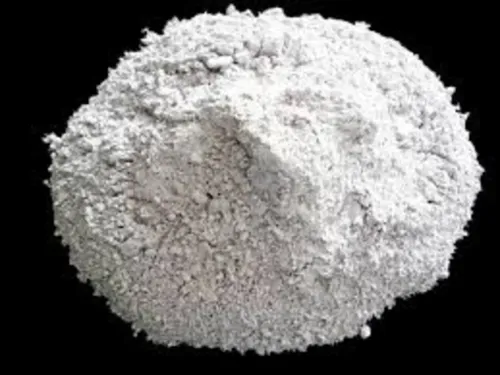
Do not choose from fineness alone. Compare chemical composition, glass content, moisture, loss on ignition, bulk density, particle-size distribution and standardized activity-index results across several lots. IVS INDUSTRIES can provide a useful comparison only when you ask for those lot-level results, not a single headline value.
Run a trial at the intended replacement percentage and water-to-cementitious-materials ratio. Check slump retention, setting, early and later strength, heat evolution and curing response before approving the binder.
Related products
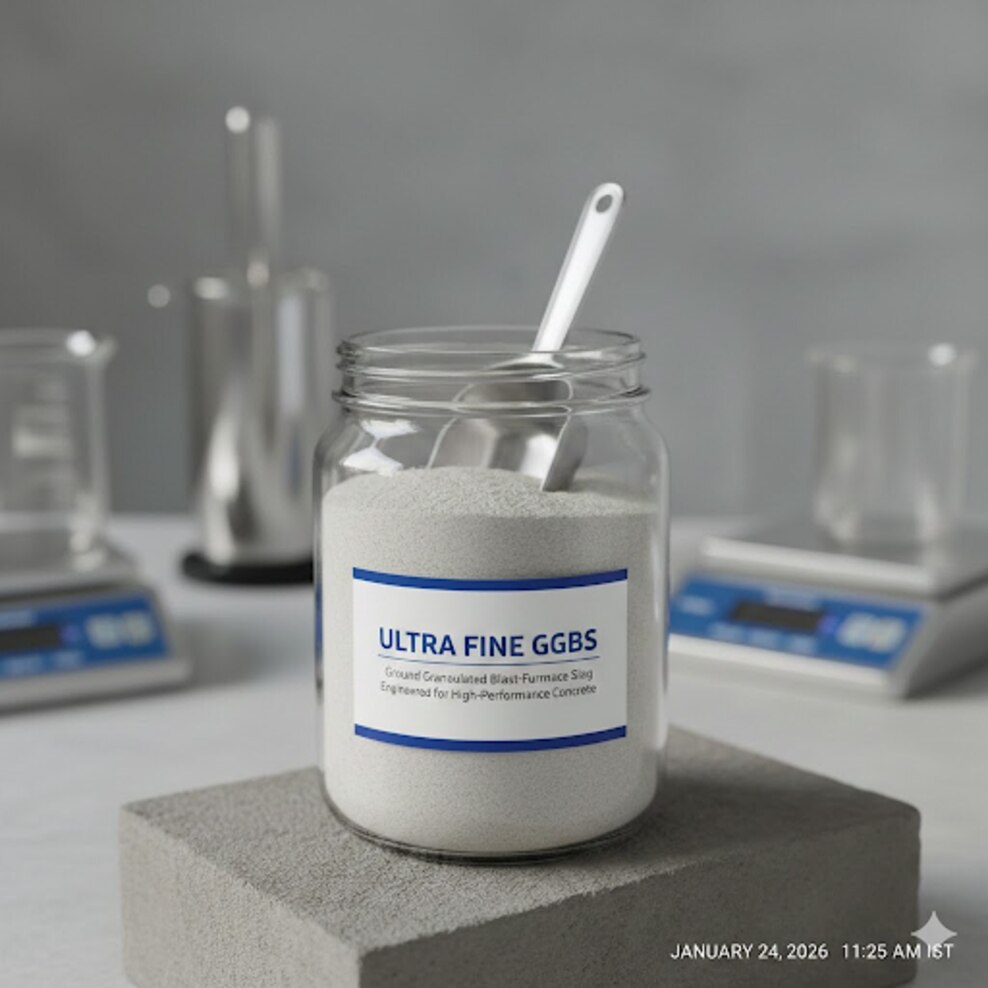
 | Ultra Fine GGBS enhances concrete’s workability, reduces permeability, and ensures long-lasting structural performance. View product → |
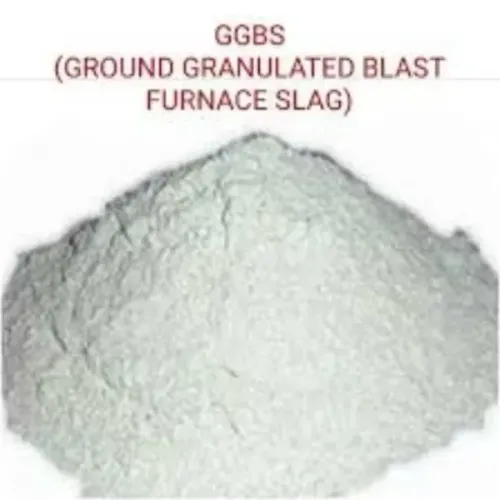
 | Ground Granulated Blast Furnace Slag (GGBS) Ground Granulated Blast Furnace Slag (GGBS) ₹2800 Ground Granulated Blast Furnace Slag (GGBS) is obtained during the steel making process, when the slag is uenched to form granules. View product → |
How to proportion, batch and cure a GGBS concrete mix
A 40% replacement changes more than the cement label: early strength, setting time, heat release, workability and curing sensitivity all change. GGBS reacts in the alkaline, calcium-rich environment created by Portland cement hydration, so the complete binder system—not slag alone—controls performance.
1. Fix the cement replacement percentage by mass of total binder. For a 400 kg/m³ binder at 40% replacement, use 240 kg Portland cement and 160 kg GGBS, not 400 kg cement plus 160 kg GGBS.
2. Complete the binder calculation before setting water. Keep the specified water-to-binder ratio, then check whether the chosen GGBS and admixture combination delivers the required slump without adding unplanned water.
3. Validate the batching sequence in a trial mix. Charge aggregates and part of the mixing water, introduce Portland cement and GGBS as separate, identified materials, then add the remaining water and admixture. Confirm that dry pockets, clumping and mixer dead zones are absent.
4. Test slump, air content, setting time and strength at the project’s required ages. Compare them with the Portland-cement reference mix; do not infer concrete performance from an activity-index grade alone.
5. Cure immediately and continuously. Protect exposed surfaces from evaporation, maintain adequate moisture and prevent cold concrete from losing early reaction. Extend curing or delay formwork removal, prestressing and traffic opening when early strength is slower.
6. Record the approved replacement percentage, batch quantities, water adjustments, temperatures, admixture dose and test results. Use that record to control every subsequent load.
Matching GGBS to chloride, sulfate, carbonation and thermal exposure
GGBS can reduce chloride ingress, improve resistance to sulfate attack, and lower heat release, but none of those benefits is automatic. Its slower reaction makes curing critical; if the surface dries early, the pore structure remains open before exposure begins.
| Exposure | GGBS contribution | Design requirement |
|---|---|---|
| Chlorides, including marine splash zones | Refines capillary pores and binds some chlorides | Verify performance with the specified chloride test, water-to-cementitious-materials ratio, cover and curing regime |
| Sulfate attack | Can improve resistance by reducing permeability and changing binder chemistry | Check slag proportion, Portland-cement composition, sulfate concentration, curing and whether exposure is external or internal |
| Carbonation | Does not remove carbonation risk | Assess cover, permeability, curing and carbonation depth; slag-rich concrete has less calcium-hydroxide reserve |
| Thermal exposure and mass concrete | Reduces heat of hydration and thermal-cracking risk | Check temperature rise, restraint, placement temperature and strength required before loading |
A mix designed for one exposure can fail another. High GGBS content may suit a thick raft but delay early strength in cold weather, formwork removal, prestressing or opening to traffic. Confirm setting and strength at the actual temperature, not only from a standard-cured cube result.
For marine and sulfate service, validate the complete concrete rather than selecting a slag grade by activity index alone. Use trial mixes to establish replacement percentage, admixture compatibility, curing duration and the project’s durability test results.
What to test, document and trace before accepting a GGBS delivery
Do not accept a GGBS delivery on fineness alone. Match the purchase specification to a current certificate of analysis, laboratory results, and a traceable batch number. The record should identify the production date, storage silo, dispatched quantity, and applicable ASTM C989/C989M or BIS specification.
Before unloading, request:
- Chemical composition, glass content, fineness or particle-size distribution, moisture, loss on ignition and bulk density.
- Standardized activity index results at 7 and 28 days, tested against the specified reference Portland-cement mortar.
- The certificate of analysis for that lot, not a generic product brochure or an old monthly average.
- Delivery notes linking the truck, silo, batch number and quantity to the laboratory report.
- A retained sample sealed and labelled with the same batch details.
| Evidence | What to check | What it tells you |
|---|---|---|
| ASTM C989/C989M grade | Grade 80: 75% at 7 and 28 days; Grade 100: 75% at 7 and 95% at 28 days; Grade 120: 95% at 7 and 115% at 28 days | Confirms standardized mortar activity, not guaranteed concrete performance |
| BIS specification | Product designation, limits and test methods match the purchase order | Shows the supplied material meets the named Indian requirement |
| Lot results | Chemistry, glass content, moisture and fineness stay within agreed control limits | Reveals consistency between deliveries |
| Traceability records | Batch, silo, dispatch date and retained sample agree across documents | Makes a failed result or field complaint investigable |
Approve the material only after comparing these results with the project mix trials. Replacement level, curing, cement chemistry and admixtures still control setting, strength and durability.
Frequently asked questions
How does GGBS manufacturing control affect concrete performance?
Control of slag chemistry, glass content, fineness, moisture and consistency affects reaction rate, setting, strength development, heat evolution and durability.
Should you use ordinary GGBS or Ultra Fine GGBS?
Choose ordinary GGBS for established blended-binder designs and routine durability needs; consider Ultra Fine GGBS when the mix requires faster reactivity, higher early strength or improved particle packing.
How do you proportion, batch and cure GGBS concrete?
Set the GGBS replacement rate through trial mixes, measure all materials accurately, control water-to-binder ratio, maintain a consistent batching sequence and protect the concrete during curing.
How do you match GGBS to exposure conditions?
Evaluate chloride ingress, sulfate attack, carbonation risk and heat limits separately, then confirm the binder design through exposure-specific testing and project specifications.
What should you verify before accepting a GGBS delivery?
Check the product designation, batch number, test certificate, fineness, moisture, chemical results, packaging or silo identity and transport records against the purchase specification.
Related product
 | Ground Granulated Blast Furnace Slag Ground Granulated Blast Furnace Slag ₹3000 State Powdered Packaging Type Bags/Bulker Packaging Size 50 kg bags/ Jumbo Bags Color Off White Grade Technical Application Laboratory We offer... View product → |