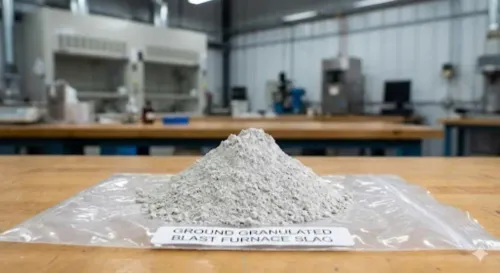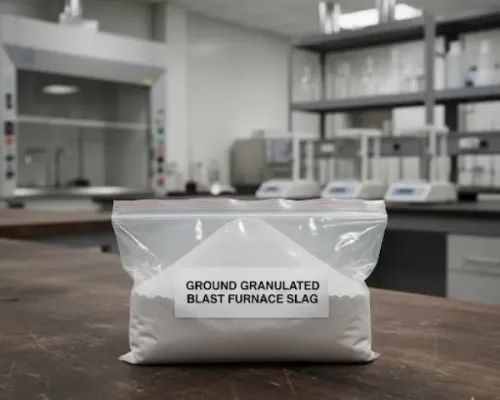

Not every concrete project needs the same binder system. Routine structural concrete, heavily reinforced elements, high-performance mixes, industrial structures, and specialized cementitious products can impose very different requirements.
For technically demanding applications, Ultra Fine GGBS may be evaluated when engineers want to modify particle packing and binder performance while incorporating a supplementary cementitious material.
The key is knowing when the additional fineness has a meaningful purpose.
Begin With the Problem the Mix Must Solve
Selecting a finer material simply because it sounds more advanced is not an effective specification strategy.
Concrete technologists should first identify the performance challenge.
This might involve:
- Dense reinforcement requiring workable concrete
- Low-permeability requirements
- Higher-performance binder systems
- Specialized grout formulations
- Repair applications
- Precast products
- Industrial concrete
- High-performance concrete
Once the requirement is defined, laboratory evaluation can determine whether an ultra-fine GGBS grade provides useful characteristics.
Fineness Influences More Than One Property
Reducing particle size increases surface area and changes the way particles fit within the cementitious matrix.
This can influence packing, reaction characteristics, water demand, admixture response, and rheology.
That is why direct substitution without testing can produce unexpected results.
A formulation developed around conventional GGBS should not automatically be assumed to perform identically after switching to Ultra Fine GGBS.
Compare Materials Using Performance Data
When evaluating conventional and ultra-fine grades, buyers should compare more than price.
Useful considerations include:
Evaluation should consider particle characteristics, including fineness and particle-size distribution, along with the material’s effect on fresh concrete, particularly flow, workability, and admixture response. For hardened concrete, the required strength at specified ages should be assessed, while durability should be evaluated according to relevant permeability and exposure requirements. The assessment should also examine production factors, such as batching and handling compatibility, as well as economics, including dosage and the overall mix cost. Finally, supply reliability should be considered to ensure the required quantity and consistent material quality are available.
The objective is not to prove that one material is universally superior. It is to identify which material better fits the specific formulation.
Trial Mixes Reduce Specification Risk
Laboratory and plant trials allow concrete producers to see how a material behaves with the cement, aggregates, water, and admixtures actually used in production.
A useful trial programme may compare multiple binder proportions while keeping other variables controlled.
Engineers can then examine fresh properties, setting behaviour where relevant, compressive strength at required ages, and any durability indicators specified for the project.
This creates evidence for decision-making rather than relying on assumptions based on product terminology.
Procurement Needs to Follow Technical Approval
Once the technical team approves a formulation, procurement must ensure that subsequent deliveries match the characteristics used during testing.
This makes supplier consistency important.
For RMC producers and contractors in Nagpur, Maharashtra, procurement planning should also consider consumption volume, delivery frequency, silo arrangements, and how changes in project demand will be communicated.
A technically successful trial has limited value if the approved material cannot be supplied consistently during full-scale construction.
When Conventional GGBS May Be Enough
Ultra-fine material should not automatically be specified for every application.
If conventional GGBS already enables the mix to satisfy required strength, workability, durability, construction, and commercial criteria, there may be little reason to introduce another variable.
The decision should be based on measurable requirements.
IVS Industries works with construction and industrial buyers requiring GGBS materials for different concrete applications, allowing procurement discussions to begin with project specifications rather than generic product assumptions.
Practical Evaluation Questions
Is ultra-fine material automatically stronger
Not necessarily. Concrete strength depends on the complete mix design, material characteristics, curing, and age of testing.
Can it change admixture demand
Changes in particle characteristics and surface area can affect rheology and admixture response, which is why trials are useful.
Should price per tonne determine selection
No. Buyers should consider dosage, performance, consistency, logistics, and total concrete economics.
Can it be introduced directly into an existing production mix
Any significant binder-material change should be technically evaluated before routine production.
The strongest reason to consider Ultra Fine GGBS is therefore not simply its finer particle size. It is whether those characteristics solve a clearly identified concrete-performance problem and can be reproduced consistently at production scale.
Keywords