A large GGBS order can fail for reasons that a product brochure will not reveal: the wrong governing standard, a certificate that describes typical rather than delivered material, or a fineness level that disrupts your concrete mix. By asking for lot-specific evidence, running a project-specific trial, and fixing supply and dispute terms before approval, you can decide whether the material is suitable and whether the manufacturer can keep supplying it consistently.
Key takeaways
- Name one governing standard, edition, grade, and test basis.
- Match chemical and physical limits to your approved concrete mix.
- Release volume only after a documented trial passes.
- Put testing, consistency, and environmental claims into the contract.
Which standard, grade, and documents will govern the purchase?
Do not approve a bulk GGBS order until one named standard, edition, grade or conformity class, and test basis appear in the purchase file. Ask the GGBS manufacturer which of these governs the material; they are not interchangeable.
| Standard | What to confirm | Why it matters |
|---|---|---|
| IS 16714 | Exact edition, declared grade, and test methods | Indian GGBS requirements and terminology apply |
| IS 12089 | Exact edition and production requirements | Covers production-related controls, not automatic product conformity |
| ASTM C989/C989M | Edition and strength-activity class | Uses standardized mortar comparison, not a direct prediction of concrete strength |
| EN 15167-1 | Edition and conformity class | Uses different acceptance criteria and test regimes |
Obtain these documents before technical approval:
- Supplier specification, safety data sheet, inspection or test certificate, and current lot-specific GGBS certificate of analysis.
- Certificate details: production lot, sampling date, laboratory, test methods, test dates, results for chemistry, fineness, moisture, and strength activity, plus the strength-activity basis.
- A delivered-batch certificate, not a generic typical-values sheet. The latter describes past or expected performance and does not prove that your shipment conforms.
- Laboratory accreditation details. Check that ISO/IEC 17025 scope covers the actual chemical, physical, and strength tests used for acceptance; accreditation alone does not certify every lot.
- Purchase-order terms for retained-sample custody, retention period, referee laboratory selection, and dispute-testing procedure.
Require the laboratory, release limits, and change-control route in writing before signing. Ask for strength-activity data using your cement and proposed replacement level, because a standard grade is not a concrete performance guarantee.
Which chemical and physical limits fit your concrete mix?
GGBS chemical requirements fit your concrete mix only when you compare a numerical material envelope with a trial mix, not a product label or a claim that finer is better.
Ask for lot-specific limits and test methods for:
- CaO, SiO2, Al2O3, MgO, total sulfur or SO3, chloride, alkalis, loss on ignition, and glass content
- Fineness, Blaine fineness, particle-size distribution or residue, density, and moisture
- The proposed replacement percentage, cement source, and GGBS strength activity at that dosage with your cement
Blaine is a surface-area index, not a complete particle-size description. Two Ultra Fine GGBS products with the same Blaine value can differ in coarse tails, agglomeration, water demand, superplasticizer demand, and strength development. Set both a Blaine limit and a particle-size distribution or residue limit.
| Mix-design question | Why it matters | Evidence to request |
|---|---|---|
| Higher fineness or controlled fineness? | Finer material can improve early reactivity but increase water and admixture demand | Water-demand, dosage, and slump-retention data |
| What replacement level? | Changing cement content affects setting, early and later strength, heat, shrinkage, and permeability | Trial results at the proposed percentage |
| Does the product suit this cement? | Standard mortar performance does not predict every concrete mix | Strength-activity data using your cement |
Write numerical limits into the purchase specification. “Conforming” alone gives you no acceptance boundary. Include curing temperature and test ages, then verify setting time, early strength, later-age strength, heat of hydration, shrinkage, and permeability in a project-specific trial.
What trial must pass before you release a large order?
Release the order only after a project-specific GGBS trial batch passes both laboratory and plant checks. Ask for a representative sample with a defined mass, production lot, sampling date, and retained-sample arrangement.
1. Run the laboratory concrete mix design with the intended cement, aggregates, admixtures, GGBS replacement percentage, mixing sequence, and curing temperatures. Test initial slump, slump retention, air content, bleeding, setting time, heat evolution where relevant, early strength and later-age strength, plus project-specific durability indicators.
2. Repeat the approved proportions in a plant trial. Record batch sequence, mixing time, discharge consistency, pumping behaviour, finishing, segregation, and temperature. A room-temperature result does not establish cold-weather performance, so test at the project’s lower curing temperatures when construction or early loading requires it.
3. Record the decision owner, numerical acceptance limits, testing ages, report format, corrective-action route, and the time required for curing and review. Do not release commercial quantities while a failed result lacks an assigned investigation and retest path.
ASTM C989/C989M strength activity compares standardized slag-cement mortar with control mortar at specified ages; it does not guarantee concrete strength at every dosage. Require actual supplier data using your cement and proposed dosage. Approve the order only when the signed trial report, plant result, corrective-action decision, and final acceptance limits are complete.
How will the manufacturer control consistency from one delivery to the next?
Require GGBS supply consistency through a documented chain from granulated slag source to receiving silo, not through the product name alone. Ask the manufacturer to identify the blast furnace source, granulation process, grinding location, storage history, blending practice, and silo identity.
Confirm whether the material is pure GGBS or contains cement, gypsum, limestone, or another supplementary cementitious material. If blended, record each constituent and its permitted range because the blend changes the chemistry, sulfate balance, alkali contribution, and performance baseline.
Put GGBS traceability and advance written notification into the contract. The supplier must notify you before changing the furnace source, granulation, grinding circuit, blending component, or storage silo, then confirm that the declared specification remains valid.
Check each delivery against a lot-specific certificate and a retained GGBS sample. Compare fineness, moisture, bulk density, colour, chemistry, and concrete performance; do not accept “same product” as evidence of conformity.
Control these receiving terms in writing:
- Dispatch moisture method and maximum guaranteed moisture
- As-delivered mass or dry-equivalent mass for invoicing
- Allowable storage duration and condensation procedure
- Caking, hardened material, and rejection process
- Pneumatic unloading rate, aeration requirement, minimum outlet size, bridging, and rat-holing
| Control | Ask for | Consequence if omitted |
|---|---|---|
| Certificates | Lot results and retained GGBS sample | Delivery disputes become harder to resolve |
| Silo handling | Tested unloading and aeration limits | Blocked outlets or unstable flow |
| Change notice | Written notice before process changes | Chemistry and performance can shift unnoticed |
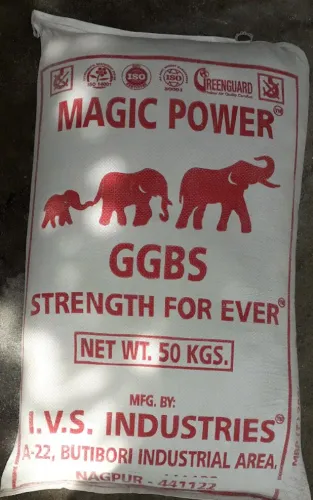
For Ultra Fine GGBS, verify bulk GGBS handling separately because finer powder can require different conveying and silo settings. Evaluate IVS INDUSTRIES through these records and controls, not an assumed promise of identical supply.
Related products
 | Ground Granulated Blast Furnace Slag (GGBS) Ground Granulated Blast Furnace Slag (GGBS) ₹2800 Ground Granulated Blast Furnace Slag (GGBS) is obtained during the steel making process, when the slag is uenched to form granules. View product → |
 | Ultra Fine GGBS enhances concrete’s workability, reduces permeability, and ensures long-lasting structural performance. View product → |
Which contract terms protect quality, testing, and environmental claims?
Make the approval enforceable by putting every acceptance condition into the GGBS contract terms, not leaving it in emails or trial reports. State the governing standard edition, grade, numerical chemical and physical limits, test methods, moisture basis, lot definition, certificate contents, sampling frequency, retained-sample period, rejection rights, replacement process, and change-notification deadline.
- Require each certificate of analysis to show the production lot, sampling date, test dates, laboratory, results, and conformity basis. Link payment and acceptance to agreed dry mass and conformity, not merely the tonnage shown on a delivery note.
- Name the release laboratory and referee laboratory. Confirm that each is an ISO/IEC 17025 laboratory whose accreditation scope covers the actual tests; assign the cost and responsibility for failed loads, retesting, collection, and replacement.
- Define written notice for changes to slag source, granulation, grinding, blending, or storage. A product name can remain unchanged while chemistry or performance moves outside the approved range.
| Laboratory | Function | Contract control |
|---|---|---|
| Release laboratory | Tests routine lots before dispatch | Identify scope, methods, sampling frequency, and certificate contents |
| Referee laboratory | Resolves disputed results | Name it in advance, define the test method, retained-sample custody, and binding result |
For environmental claims, request a product-specific environmental product declaration. Record its programme operator, declared unit, product category rules, allocation method for blast-furnace slag, system boundary, and validity period; compare declarations only when those bases match.
Do not release a large order until the documents, mix trial, delivery controls, dispute terms, and responsible signatory are recorded.
Frequently asked questions
Which documents should you request before buying bulk GGBS?
Request the named standard and edition, grade or conformity class, test basis, current test certificates, product specification, safety information, and traceability documents for the proposed material.
How do you decide whether GGBS chemical and physical limits fit your mix?
Compare the manufacturer’s declared chemistry, fineness, density, strength contribution, setting behaviour, and other agreed limits with your mix design, cement source, admixtures, exposure class, and performance requirements.
What trial should pass before releasing a large GGBS order?
Run a controlled concrete trial using the proposed GGBS, cement, aggregates, water, and admixtures. Record workability, setting, strength at the specified ages, temperature, and durability tests required by the project.
How can a buyer check consistency between GGBS deliveries?
Agree batch identification, sampling frequency, retained samples, test methods, certificate timing, acceptance limits, nonconformance handling, and the process for investigating results outside those limits.
Which contract terms protect GGBS quality and environmental claims?
Specify the governing standard, grade, acceptance tests, inspection rights, rejection procedure, replacement or refund terms, change-notification duties, delivery tolerances, and evidence supporting any recycled-content or emissions claim.
Related product
 | Ground Granulated Blast Furnace Slag Ground Granulated Blast Furnace Slag ₹3000 State Powdered Packaging Type Bags/Bulker Packaging Size 50 kg bags/ Jumbo Bags Color Off White Grade Technical Application Laboratory We offer... View product → |