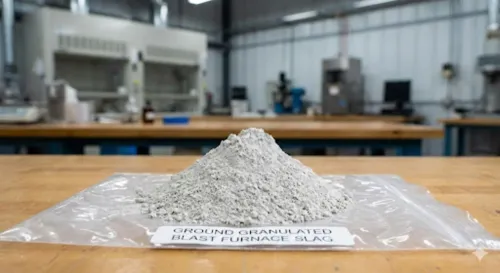
Durable concrete depends on more than adding a supplementary cementitious material: the slag’s glass content, chemistry, fineness, storage condition and dosage all affect the finished mix. By the end, you will know which manufacturer controls to check, how to set trial replacement levels, and how to protect performance during batching, curing and delivery.
Key takeaways
- Ask for glass content, fineness, chemical analysis and test results.
- Match GGBS replacement level and fineness to the exposure class.
- Check producer controls, batch traceability and storage conditions.
- Protect performance with dry storage, accurate batching and adequate curing.
The manufacturer controls the slag’s starting reactivity
GGBS manufacturers determine whether the powder starts as a reactive supplementary cementitious material or merely as a mass replacement for Portland cement. Rapid granulation and quenching cool molten slag quickly, preserving a predominantly vitreous structure; slow cooling leaves more crystalline material, which reacts less readily. Measure glass content, not fineness alone.
Grinding is another performance-control step. Mills and classifiers set particle-size distribution: excessive coarse particles delay early reaction, while too many ultrafine particles can increase water demand, agglomeration and heat release. The chemical composition of GGBS—especially the balance of calcium, silicon, aluminium and magnesium oxides—also affects reaction rate and compatibility with the cement.
Ask for lot-to-lot limits and test methods, not only a certificate showing average chemistry.
- Glass content and reactivity results, with the sampling frequency and method.
- Fineness, particle-size distribution, moisture, loss on ignition and insoluble residue.
- Strength-activity results and the applicable ASTM C989/C989M grade: Grade 80, Grade 100 or Grade 120.
| Control | Why it matters | Failure consequence |
|---|---|---|
| Granulation and quenching | Preserves vitreous, latent-hydraulic phases | High crystalline content reduces reactivity |
| Milling and classification | Balances early reaction against water demand | Slow strength gain or poor workability |
| Chemistry and moisture control | Keeps reaction and batching consistent | Variable setting, strength and durability |
| Strength-activity testing | Confirms performance beyond chemistry averages | A compliant label still fails the intended mix |
How GGBS changes concrete durability and mix design
Replacing Portland cement with GGBS usually produces reduced permeability as slag hydration refines the pore structure and increases chloride binding. That slows chloride ingress, while altered reaction products can reduce sulfate attack.
The result depends on curing, water-to-binder ratio, replacement level, cement chemistry and exposure; GGBS does not automatically replace a sulfate-resistant cement designation or project-specific testing.
The binder change also alters the working proportions of the mix:
- Set the total cementitious-material content for the required strength, workability and durability; replace part of the Portland cement with GGBS rather than adding it on top.
- Control the water-to-binder ratio instead of adding water to correct slower early workability. Extra water can erase the permeability benefit.
- Recheck superplasticiser dosage through trial batches. GGBS fineness and particle shape change flow, cohesion and admixture demand.
- Allow for slower setting and early-strength development when planning finishing, formwork stripping or opening to traffic.
GGBS normally lowers heat evolution and the heat of hydration, reducing early temperature rise in mass concrete. That benefit comes with slower strength gain, especially in cold conditions. Ultra Fine GGBS can improve early reactivity but may increase water or admixture demand; do not substitute it for ordinary GGBS at equal mass without testing.
Cure longer and protect exposed concrete: low early alkalinity and poor curing can accelerate carbonation and reduce reinforcement protection.
Choose replacement level and fineness for the exposure
Start with a GGBS replacement percentage of 25–40% for general structural concrete, using ordinary GGBS with a Blaine fineness around 350–450 m²/kg. Treat these figures as trial ranges, not universal prescriptions.
| Application | Starting replacement | Fineness to trial | Main reason and caution |
|---|---|---|---|
| General structural concrete | 25–40% | Ordinary GGBS, 350–450 m²/kg | Balances durability, workability and strength development |
| Mass concrete | 40–60% | Ordinary GGBS, 350–500 m²/kg | Limits heat evolution and temperature rise; check slower early-age strength |
| Marine or sulfate exposure | 40–60% | Ordinary GGBS, 400–600 m²/kg | Targets lower chloride ingress and sulfate damage; verify the cement, curing and exposure chemistry |
| Early-strength applications | 15–30% ordinary, or 20–35% Ultra Fine GGBS | Use the producer’s declared higher fineness and test it | Supports early-age strength, but higher fineness can increase water demand, admixture demand and shrinkage |
Ultra Fine GGBS is a commercial fineness description, not a universal performance class. Do not replace ordinary GGBS on an equal-mass basis without testing setting time, water demand, workability, heat evolution, shrinkage, strength and durability.
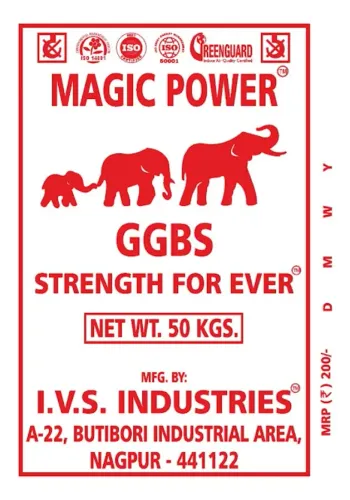
Ask IVS INDUSTRIES for the declared fineness and trial data for the exact product and dosage. Confirm stripping, traffic-opening and cold-weather schedules against the measured strength, then protect high-replacement mixes with adequate curing because low early alkalinity and carbonation can reduce reinforcement protection.
Related products
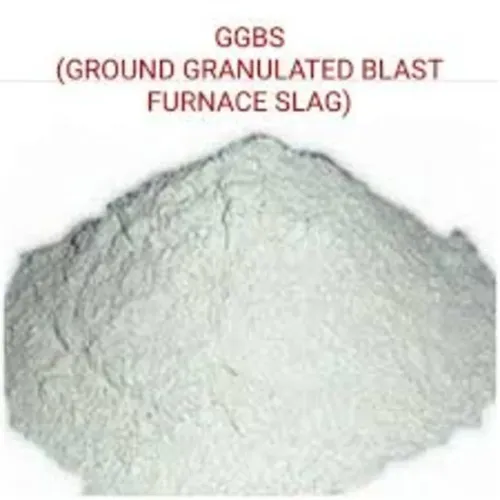
 | Ground Granulated Blast Furnace Slag (GGBS) Ground Granulated Blast Furnace Slag (GGBS) ₹2800 Ground Granulated Blast Furnace Slag (GGBS) is obtained during the steel making process, when the slag is uenched to form granules. View product → |
 | Ground Granulated Blast Furnace Slag Ground Granulated Blast Furnace Slag ₹3000 State Powdered Packaging Type Bags/Bulker Packaging Size 50 kg bags/ Jumbo Bags Color Off White Grade Technical Application Laboratory We offer... View product → |
Test the producer, not just the product label
A dependable producer can show batch-to-batch evidence, not merely print a grade on the bag. Request a certificate of analysis for each lot, with the test method, result and acceptance limit for chemistry, fineness, moisture, loss on ignition, insoluble residue, glass content and strength activity.
Ask for these records:
- Conformity to IS 12089 for GGBS, or ASTM C989/C989M Grade 80, Grade 100 or Grade 120. ASTM grade measures strength activity; it is not a direct durability rating.
- The producer’s control limits and trend records, not only an average chemical analysis. Similar Blaine fineness does not guarantee similar reactivity when glass content or furnace chemistry changes.
- Granulation, quenching and grinding records showing that rapid cooling preserved a predominantly vitreous structure.
- An explanation for any reference to IS 3812. That standard covers pulverized fuel ash, so it does not by itself demonstrate GGBS compliance.
Compare the paperwork with independent results from sealed samples drawn from separate lots:
| Evidence | What it reveals | What it cannot prove |
|---|---|---|
| Certificate of analysis | Whether each lot meets declared limits | Performance in your concrete |
| Factory trend records | Whether chemistry and fineness drift over time | Correct site storage or batching |
| Independent laboratory tests | Whether reported properties are reproducible | Durability of an untested mix |
| Trial concrete batches | Setting, water demand, strength and permeability at your dosage | Performance under every exposure condition |
Reject a supplier that cannot identify the lot, test method, sampling point and release limit. A polished certificate without traceable controls is not consistency evidence.
Protect the mix through storage, batching and curing
Keep GGBS storage dry, sealed and separate from other powders. Silo storage needs a weatherproof vent, intact seals and dedicated transfer lines; moisture pickup causes caking, while Portland cement or hydrated lime contamination changes the binder chemistry. Record the supplier lot, silo, delivery date and batch number for batch traceability.
- Weigh GGBS on calibrated scales as a separate binder component. Do not estimate it by volume or compensate for suspected moisture without testing the material.
- Blend GGBS with Portland cement and aggregates in the approved sequence until the powder is uniform. Keep the water-to-binder ratio at the trial-mix value; extra water removes the permeability benefit.
- Control admixture addition and mixing time against the validated mix. Slag hydration can slow setting, and poor dispersion creates local pockets with different strength and durability.
- Start curing as soon as finishing permits. Prevent evaporation with curing compound, wet coverings or sealed protection, and maintain protection through the specified curing period.
- Protect fresh concrete from low temperatures and temperature shocks. Cold slows slag hydration, while premature drying stops the continued reaction that refines pores.
Do not strip formwork or open the concrete to traffic by age alone when replacement is high or temperatures are low. Confirm in-place strength and validate the curing duration for the actual climate and section size; inadequate curing also increases carbonation risk by reducing reinforcement protection.
Frequently asked questions
How does a manufacturer control GGBS reactivity?
Rapid granulation and quenching preserve a predominantly vitreous structure. Ask for glass-content data because fineness alone does not prove reactivity.
How does GGBS affect concrete durability and mix design?
GGBS can reduce permeability and improve resistance to aggressive exposure, but it changes early strength, setting time, water demand and curing requirements.
How do you choose GGBS replacement level and fineness?
Select them against the exposure, required strength-development rate and curing conditions. Higher replacement or finer material is not automatically the best choice.
What should you check when evaluating a GGBS manufacturer?
Review laboratory test results, production controls, batch traceability, consistency between deliveries and documentation covering composition and performance.
How should GGBS be stored, batched and cured?
Keep it dry in sealed silos, prevent cross-contamination, weigh it accurately during batching and provide curing that supports its slower early reaction.
Related product
 | Ultra Fine GGBS enhances concrete’s workability, reduces permeability, and ensures long-lasting structural performance. View product → |