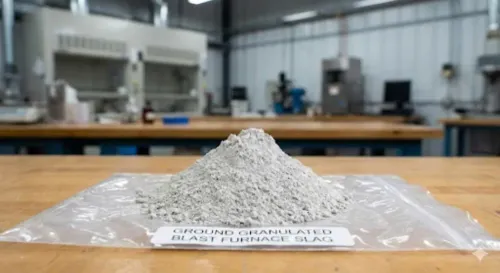
A low price and a certificate marked “GGBS” do not prove that a supplier can deliver the right material, in the right quantity, with predictable concrete performance. Use the checks below to compare manufacturers, verify each lot, set trial-mix requirements, and build protection against quality or supply interruptions into the purchase contract.
Key takeaways
- Match peak monthly demand to verified production and dispatch capacity.
- Request lot-level test reports, batch identity and traceability records.
- Trial fineness and cement replacement levels in your own concrete mix.
- Put delivery frequency, storage and missed-shipment remedies in writing.
Qualify the manufacturer’s capacity before discussing price
An annual output figure does not prove that a supplier can sustain your project. Qualify GGBS manufacturers against your peak monthly requirement, delivery frequency and the consequences of one missed shipment before comparing price for bulk GGBS supply.
1. State your demand profile: total tonnes, expected monthly draw, peak-month volume, first-delivery date and required delivery frequency. Ask the manufacturer to confirm production capacity in tonnes per month and the maximum dispatch volume available for your project.
2. Request written evidence of reserve capacity, not a verbal assurance. Ask how much capacity remains after existing contracts, planned furnace outages, grinding-mill maintenance and peak-season demand. A supplier operating at full utilisation has little room to recover from disruption.
3. Record the normal lead time, emergency lead time, minimum order quantity and dispatch limit per truck, rail movement or vessel. Compare these figures with your silo capacity and the number of days your site can operate without replenishment.
4. Identify the manufacturing plant, grinding location and storage terminal that will serve you. Confirm whether the proposed source depends on one blast furnace, one mill or one terminal; any single-point failure needs a documented alternative.
5. Require an interruption plan covering furnace outages, mill breakdowns, port disruption and transport shortages. It should name an alternate approved source, available reserve stock, notification periods and the requalification process after a source change.
Do not approve a cheaper quote until these answers show continuous supply through the project programme. A technically compliant GGBS product still becomes a costly choice when an unplanned gap stops concrete production.
Demand lot-level evidence of identity and quality
A delivery is not traceable GGBS unless its powder can be tied to a defined production or grinding lot. Before the first bulk shipment, agree how a lot is formed, how long records are retained, and how a retained sample will be sealed and stored.
Request these documents for every delivery:
- A certificate of analysis showing the test date, batch number or lot number, source of slag, grinding location, fineness, chemical composition, moisture, loss on ignition and activity or strength-index result.
- The approved source list, including the production plant, grinding mill and any terminal used for blending or dispatch.
- A signed declaration that the material is GGBS, not cement, fly ash or an undisclosed blend.
- A retained sample reference linked to the delivery documents and vehicle or silo identification.
| Evidence | What to compare | Failure it can expose |
|---|---|---|
| Fineness result | Contract limit and stated test method | Wrong grind or excessive variation |
| Chemical analysis | Agreed limits for oxide composition and loss on ignition | Source change or contamination |
| Moisture result | Declared limit at dispatch | Wet powder, handling problems or false mass |
| Activity result | Specified strength index at the stated ages | Chemistry that does not deliver concrete performance |
| Independent laboratory test | Sample sealed at receipt and tested against the same methods | Certificate error or product substitution |
Require advance notice and requalification after a source of slag, furnace, grinding mill or blending arrangement changes. A passing certificate without that chain of identity does not prove that the tested powder is the powder in your silo.
Compare standards, grades and measurable product limits
Do not accept “complies with GGBS standards” as a specification. Your purchase order must name the governing standard and edition, the grade or class, the test method, and each acceptance limit; otherwise two suppliers can claim compliance using different benchmarks.
| Standard | What it controls | How to compare |
|---|---|---|
| IS 12089 | Indian requirements for GGBS | Check the specified chemical and physical limits; use applicable IS 4031 methods for testing |
| ASTM C989/C989M | Slag-cement strength-activity grades 80, 100 and 120 | Check the grade, test age and reference cement |
| EN 15167-1 | GGBS requirements for concrete, mortar and grout | Check every listed chemical, physical and conformity requirement |
Compare the actual numbers, not the certificate’s conclusion. Review moisture, loss on ignition, insoluble residue, sulfate, sulfide sulfur, chloride, relevant alkalis and fineness against the selected standard and the project’s exposure requirements.
Read an activity-index result with its test age and reference cement; it classifies the material but does not guarantee early strength in your mix.
Ask for these items before approval:
- A lot-linked certificate of analysis reporting the agreed limits and test results.
- The supplier’s definition of “ultra-fine,” including particle-size distribution and specific surface; neither ASTM C989/C989M nor EN 15167-1 makes it a universal grade.
- Contractual limits for moisture, storage condition and performance at the stated replacement percentage.
- An independent test plan for any result outside the declared range or after a source change.
A supplier’s limit copied from another standard is not evidence of compliance. Require the applicable standard beside every reported value.
Validate fineness and replacement percentage in your own mix
Run side-by-side concrete trials at the proposed replacement percentage using the project’s cement, aggregates, admixtures and curing regime. Compare standard GGBS with Ultra Fine GGBS only after confirming that both follow the specified compliance route, such as ASTM C989/C989M or EN 15167-1.
Record these trial outputs:
- Initial and final setting time, because higher slag replacement can delay setting under cold curing.
- Compressive strength at the specified early age and at later ages, rather than treating the supplier’s activity index as a guaranteed project result.
- Water demand, air content and admixture dosage needed to achieve the target slump and air content.
- Bleeding, finishing behaviour and surface appearance.
- Temperature rise or heat evolution where thermal control matters.
Test the intended replacement percentage plus a lower and higher level if the design allows it. That reveals whether a small fineness advantage justifies a different dosage or a higher material cost.
Define Ultra Fine GGBS by measurable limits, not by its label or Blaine value alone. Request fineness, particle-size distribution measured by a stated method such as laser diffraction, residue above 45 µm where relevant, moisture and storage condition.
Read every activity index with its test age and reference cement; two products with similar Blaine fineness can behave differently because of agglomeration and particle distribution. Approve the material only when the trial meets strength, setting and workability targets with your actual mix.
Convert trial results into delivery, storage and contingency terms
Approval is not a supply guarantee. Put the tested mix’s curing requirements, permitted replacement level and minimum early strength into the purchase specification, then link deliveries to the pour programme rather than ordering powder only when a silo is nearly empty.
- Record normal and surge capacity, lead times, minimum order quantity, delivery frequency and the location of each storage terminal.
- Specify dry, sealed silo storage, maximum holding time, receiving inspection and the action for moisture, caking or blocked discharge.
- Name the approved slag production source or source family. Require advance notice of any furnace, granulation, grinding or blending-source change and require requalification before use.
- Require an alternate approved source, reserve stock and an escalation contact for furnace outages, mill maintenance, port disruption or demand spikes.
| Control | Contract term | Schedule protection |
|---|---|---|
| Source continuity | Written notice before source change; trial and approval after change | Prevents an unverified chemistry change entering production |
| Delivery performance | Agreed lead time, delivery frequency, minimum stock and missed-delivery remedy | Protects pours from avoidable silo shortages |
| Contingency supply | Named alternate source with compatible specification and activation procedure | Provides a tested replacement during an outage |
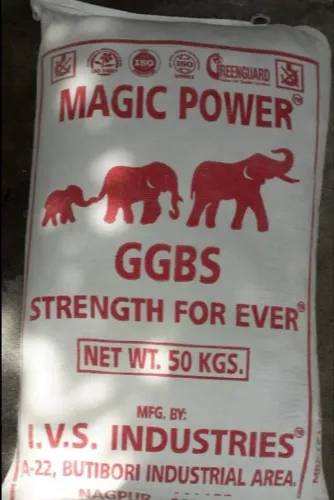
For a supplier such as IVS INDUSTRIES, ask for a written dispatch plan showing silo capacity, replenishment triggers and the evidence supporting its alternate source. Include lot traceability on every delivery; a technically compliant powder delivered late still stops concrete production.
Frequently asked questions
How should you qualify a GGBS manufacturer before comparing price?
Compare verified production and dispatch capacity with your peak monthly requirement, delivery frequency and the impact of a missed shipment. Ask for evidence that the manufacturer can sustain your required supply schedule.
What documents should you request for each GGBS lot?
Request the lot or batch number, certificate of analysis, test date, manufacturing details and test results that identify the material and confirm its quality. Check that the documents match the bags, silos or tanker delivery.
Which GGBS quality characteristics should you compare?
Compare the stated standard, grade and measurable limits for characteristics such as fineness and other specified quality parameters. Do not compare products using price per tonne alone when their limits or test methods differ.
How can you validate GGBS before full-scale supply?
Run a controlled trial in your own cement and concrete mix. Test the proposed fineness and replacement percentage, then record workability, setting, strength development and any changes needed to batching or curing.
What should a bulk GGBS supply agreement cover?
Define delivery frequency, order lead time, lot documentation, storage conditions, stock responsibility, rejected-load handling and the response to a delayed or missed shipment. Include contingency arrangements before the first bulk delivery.